
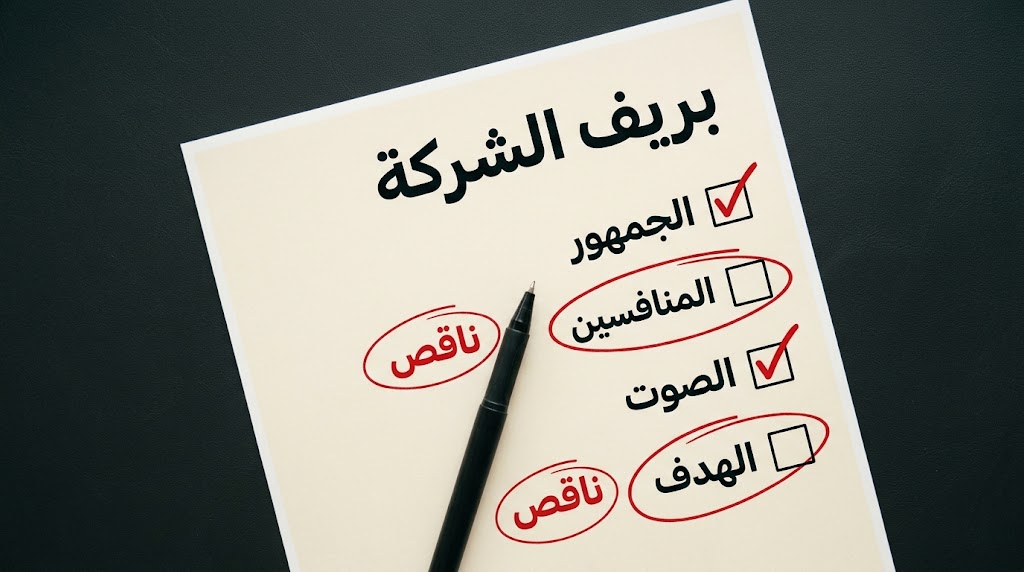
A minimal prompt written for one company ended up accidentally producing a full strategy for a different one — because AI built on the information available, nothing more. That's exactly the value of a proper brief: the difference between a generic output and a precise one is the information you provide.
An AI company brief is a fixed file with accurate information about your business (audience, competitors, voice, goals) that you feed to any AI model before asking it to work — so every output builds on your business's actual reality, not a generic guess.
Direct definition: a company brief is a fixed reference document containing core business information (who the audience is, who the competitors are, what the voice and style are, what the current goal is) used as fixed context for any AI request, instead of re-explaining the same information every time.
A real story: a minimal prompt built a strategy for a different company
A case happened that illustrates the principle precisely: a prompt written with incomplete information about a specific company actually produced a strategy built on assumptions that ended up applying more to a different company — because AI fills gaps with its own logic when the information isn't there. The result isn't "wrong" in a technical-error sense; it's exactly what happens with an incomplete brief: an output that looks reasonable but is built on assumptions, not your reality.
What should a brief include?
- A precise description of the business and product: not generic marketing copy — a clear description of who buys and why.
- 3-5 named competitors: so any comparison or positioning is built on reality.
- Voice and style: real examples from past content reflecting your style.
- The current goal specifically: a number and a date, not a generic "increase sales."
Why is a fixed brief better than re-explaining every time?
Re-explaining the same information in every conversation takes time, and opens room for forgetting an important detail or stating it differently each time — which is exactly what produces inconsistent output. A fixed brief ensures every request, from anyone on the team, builds on the same accurate information.
What a brief does NOT do
- It doesn't eliminate the need to verify output. Even with a complete brief, you still need to review the result — the brief reduces errors, it doesn't eliminate them.
- It needs periodic updates. If the market, competitors, or goals shift, an outdated brief produces outdated output.
- It doesn't replace your own understanding of your business. It's an information-transfer tool, not a substitute for your expertise.
FAQ
How often should I update the brief?
Whenever something fundamental changes — a new competitor, a new goal, a shift in target audience. At minimum, review it every 3 months.
Does the same brief work for every task (content, strategy, design)?
The core brief (business, audience, competitors) is the same across tasks, but you can add a specific section per task type (like text examples specifically for content).
What happens if the brief is incomplete?
AI fills the gap with reasonable but generic assumptions — the output looks plausible but may be built on a reality that isn't actually yours.
Who should write the brief?
Whoever understands the business best in practice — the owner or a direct manager, not someone removed from strategic decisions.
⚡ Set up your ad system in 5 days — $390 only
Audit + setup + your first campaign, live and ready. A clear result, or your money back.
Book your spot now — $390 ⏱ Only 5 spots this month